Blog
The Real Cost of API Dependence
April 17, 2026
Why the cheap API option ends up costing more — a deep dive into the economics of AI agent deployment
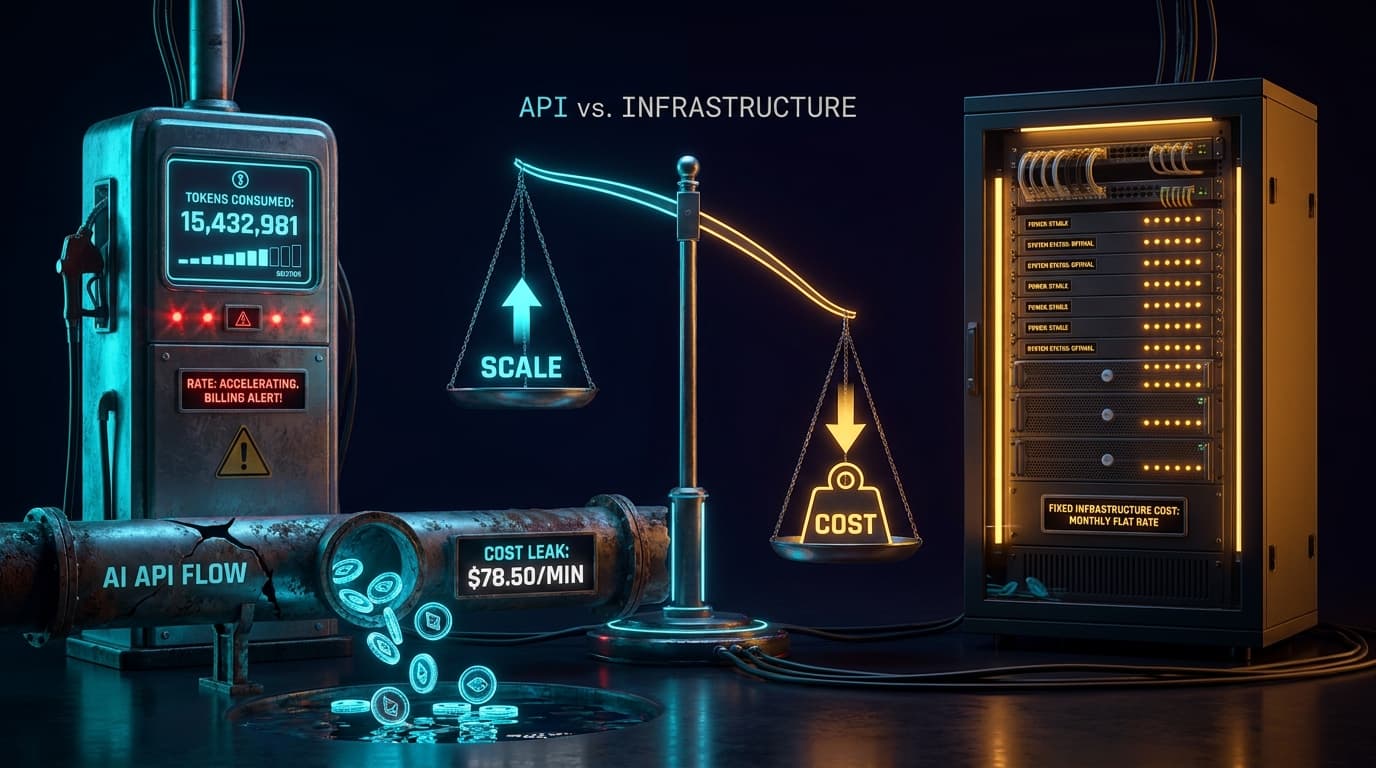
The sticker price looks appealing. Pay per token, no upfront hardware, scale up or down instantly. Cloud AI APIs promise flexibility, but that flexibility has a price — and it compounds over time in ways that aren't obvious until you're already locked in.
This post breaks down the actual economics of API dependence versus self-hosting, and why the "cheap" option usually becomes the expensive one.
The Opaque Pricing Problem
Cloud AI APIs price in tokens. Input tokens, output tokens, different rates for different models. On the surface, it's straightforward: you use what you need, you pay for what you use.
But here's what the pricing pages don't make obvious:
Prompt inflation — As your agent gets more capable, your prompts get longer. System instructions, few-shot examples, chain-of-thought reasoning — all consume tokens you're not directly billed for in the "output" column but that still hit your invoice. A prompt that cost 500 tokens in January might cost 3,000 tokens by December as you add more context.
Latency tax — When you're building agents that make multiple API calls in a workflow, network latency adds up. That's time your agent isn't working, your users are waiting, and you're still paying for the eventual output. Self-hosted? That's your local network — milliseconds, not seconds.
Rate limit throttling — At scale, you hit rate limits. You then either pay for higher tiers, implement complex retry logic, or just wait. None of these are free. Self-hosting means your hardware, your limits.
Business model misalignment — Cloud providers want you to use their most expensive models for complex tasks. There's a constant pull toward "just use GPT-4 for this" because that's where their margins are highest. When you run your own models, you choose what's appropriate — not what's most profitable for the API provider.
The Arithmetic of Scale
Let's do some numbers. These are rough figures — your mileage will vary — but the ratios are what matter.
Scenario: 50,000 agent interactions per day
Assuming an average of 2,000 tokens per interaction (input + output combined), that's 100 million tokens per day.
At typical API pricing of $2-3 per million output tokens (depending on model), plus similar input costs... you're looking at $150-250 per day, or $4,500-7,500 per month.
Now consider what you'd spend on self-hosted hardware:
A decent GPU server (RTX 4090 or equivalent) costs roughly £2,000-3,000 to buy. Running a capable open-source model locally, you'd handle those 50,000 interactions at a fraction of the per-token cost. Your marginal cost is electricity — maybe £2-3 per day for that workload, depending on utilisation.
So: £5,000/month API versus £200/month electricity. The hardware pays for itself in 4-6 months.
But this gets even more favourable as you scale. Every additional 50,000 interactions costs you essentially nothing extra with self-hosted — just more electricity and a bit more RAM. With APIs, it's linear: more usage = more money, forever.
The Hidden Costs Nobody Talks About
Beyond direct spending, there are secondary costs that tip the economics further toward self-hosting:
Data governance — When you send every prompt and response through a third-party API, you're creating data copies you don't control. GDPR, compliance, IP concerns — all become more complicated. Self-hosted means data never leaves your infrastructure.
Competitive parity — If you're building on the same APIs as everyone else, using the same models with the same system prompts, you're competing on top of a commodity. Your differentiation has to come from somewhere else. Self-hosting lets you fine-tune, experiment with different models, and own your deployment stack.
Reliability engineering — Handling API failures, fallbacks, degraded mode handling — that's code you write, test, and maintain. Self-hosted means you control availability. No cascading outages from an API provider's incident.
When API Makes Sense
This isn't a blanket case against cloud AI APIs. There are genuine use cases where they make sense:
- Spike handling — If you have highly variable, unpredictable demand and don't want to buy hardware for peak capacity that sits idle most of the time
- Experimentation — Early-stage projects where you don't yet know what volume you'll have
- Model diversity — If you need access to multiple model families and don't want to manage several different deployments
But for any serious, sustained production workload — where you're running agents continuously, at volume, as part of your core product — the economics favour owning your compute.
The Real Question
The question isn't whether APIs are "expensive" (they might be fine for your current scale). The question is: at what scale does it make sense to own your infrastructure, and what does that transition look like?
For most teams building AI agents as part of their product, that crossover point comes faster than they expect. The moment you're doing more than a few hundred interactions a day, the self-hosted math starts working in your favour. The moment you're doing thousands, it's not even close.
The cloud providers know this. That's why they push so hard on "start with API, migrate later" — because "later" often never comes, and by then you're deeply embedded in their pricing model.
What Self-Hosting Actually Costs
Let's be real about hardware costs too, so this isn't one-sided:
- GPU compute — RTX 4090 or H100 for around £2,000-5,000 depending on availability
- RAM — 64-128GB for large models, another £300-600
- Storage — Fast NVMe for model weights, £200-400
- Networking — 10GbE if you're doing distributed setups, but mostly negligible
- Electricity — £1-3/day depending on utilisation
- Maintenance — Time to manage updates, monitor, handle failures
Compared to £5,000+/month API bills, the payback period is measured in months. After that, you're running at 10-20% of the API cost — with full control, no rate limits, and data that stays yours.
The economics are clear. The question is whether you're willing to take on the operational responsibility. For many teams, that's the real tradeoff — not the money, but the ops burden.
And if ops burden is your concern, that's exactly what we're building with Agentic Hosting — the self-hosted model, the operational headaches handled for you.